Green Impact Index: From scoring to continuous improvement - Pierre Fabre x Ecocert interview
Thursday, 08 October 2026
In our new interview, Delphine Proesmans, Green Mission Promotion Project Manager at Pierre Fabre, shares the group’s experience as the founder of the Green Impact Index Consortium and discusses the goals of this scoring tool designed for cosmetics, dietary supplements, and wellness products.
- Pierre Fabre helped create the Green Impact Index. What was the initial intention, and what need were you trying to address?
The Green Impact Index is indeed a Pierre Fabre initiative. We had been working on eco-design for over a decade, specifically with the Ducray brand on its extra-gentle shampoo, which has become a benchmark. That’s where it all started.
We participated in working groups in France and Europe to address these issues, and we realized we lacked an internal tool to identify criteria related to eco-design. Initially, all our discussions focused on internal improvements, but then we began thinking about how to communicate these efforts to external stakeholders. So we worked on the criteria we felt were relevant to identify areas for improvement and to meet consumer needs, and we also incorporated the societal aspect.
We felt it was important to highlight other aspects that complement eco-design, such as organic, biodiversity, and societal factors—including brand commitments, animal welfare, and, more broadly, all sustainable practices. . So we launched the Green Impact Index in June 2021, based on 20 criteria. And fairly quickly, other companies reached out to us to discuss our methodology. Some had already developed an internal-only tool but hadn’t taken it a step further to communicate with consumers.
We created a think tank and decided to standardize the methodology through an AFNOR specification, with the goal of moving toward a standard—first in France and then at the European level. Twenty-six companies, with 120 experts, worked together for nine months to develop a more rigorous methodology based on approximately 50 criteria, while maintaining the breakdown of 80% environmental criteria and 20% social criteria. AFNOR Spec 2215 was published in June 2023.
Next, we formed the association, launched the Green Impact Index through the Consortium, and then recruited new members.
With the methodology now in place, the question remains regarding its practical implementation and the reliability of the data.
- How did the Ecocert audit actually go?
Consortium members have access to a calculation tool that allows them to enter all the data and automatically calculate the score. On our end, the process is 100% automated: subject-matter experts enter the data, which is updated based on product changes, and the product sheet is then updated accordingly.
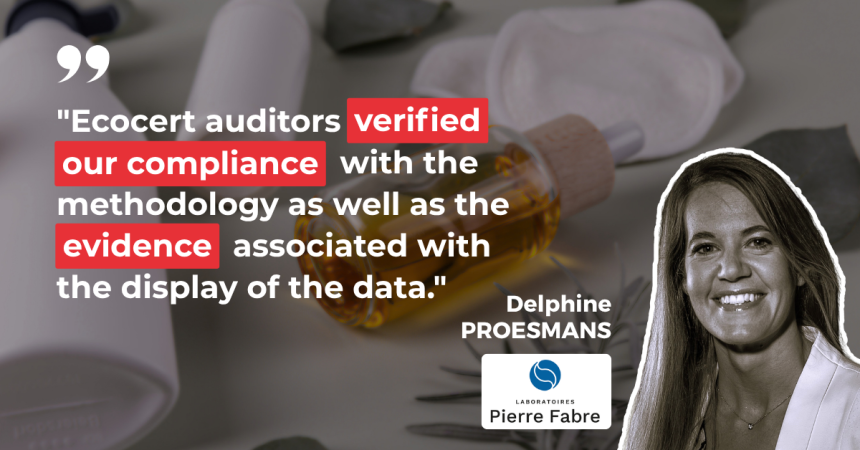
The Ecocert auditors therefore verified our compliance with the methodology as well as the evidence supporting the data displayed. We’ve already undergone two audits. Within six months of the initial product disclosures, an initial two-day audit is conducted to ensure reliability: sampling of rated products, interviews with subject-matter experts (data reliability, suppliers, control points). Minor non-conformities were identified and subsequently resolved.
In the event of a minor non-conformity, the consortium’s specifications require a second audit 18 months later. So, we’ve scheduled an appointment with Ecocert!
- What information was the most challenging to compile, and what did this process reveal about your practices (beyond the score)?
Collecting the data needed to calculate the GII score is the most demanding part; it requires time that must be carefully estimated in advance. You need to map out what’s missing and what data you need to gather in order to perform the GII calculation. Once the data has been collected, you must ensure its quality and make sure it is kept up to date in line with changes made to the product. Ultimately, this is a virtuous cycle because all stakeholders—whether internal or external—gain expertise.
- When we look at the product ratings as a whole, what key insights emerge for Pierre Fabre?
Fortunately, we’ve been working on these issues for a long time. As of today, 78% of our products are rated A or B, and no product is rated E. So this is positive, because it shows that we’re on the right track and that we’ve already been implementing measures for several years that can be objectively assessed through the GII.
Depending on the brand, some product lines are predominantly rated A or B, while others still have some products rated C or D. And even within the same letter, the level can vary: a “C” can be closer to a “B” or to a “D.” This more detailed analysis is driving brands to improve their products.
Already, certain key products are being redesigned to achieve a better score. The advantage is that the GII allows us to identify very precisely—by brand, product line, and product—which eco-design criteria to focus our efforts on. It is a very powerful tool for driving improvements and enhancing products. We’ll be able to track how brands evolve over time.
- How do you communicate about the Green Impact Index today?
At a minimum, the score must be displayed on the product pages of the brands’ websites. These pages include details by criterion and all associated claims. This is of great interest to consumers, who can access all the information.
Communication can also take place at the point of sale and on e-commerce sites to promote the GII to e-retailers. Finally, we are finalizing our plans for displaying the score on packaging—as there is strong consumer demand—and are currently drafting a communication guidelines document to provide a framework for this aspect among our members.
- What would you say to a brand that’s still hesitant to get started?
Choosing the Green Impact Index is an ambitious goal. But it’s a process that happens in several steps. You start by selecting a Top 5 or Top 10 list of products, then follow a realistic, achievable path.
Yes, it takes time—but it’s time well spent. You stay ahead of regulations and the information you need to collect from your suppliers, you build your expertise, identify areas for improvement in eco-social design, and communicate all of your commitments to your stakeholders through a rating: this isn’t just work for the sake of it. It’s exactly what consumers expect—transparency and honesty. All of this is beneficial; there’s no reason not to move forward. It’s a powerful tool for transforming businesses throughout the value chain.
If a company is hesitant, it can certainly rely on AFNOR Spec 2215 and use it as a roadmap while it makes progress on these aspects.
The other option is to join the Consortium as an Observer member, which allows the company to test the methodology and the rating tool for one year before deciding whether to become an Active member and disclose its ratings or to leave the Consortium.
An inspiring testimony that illustrates the value of an approach based on reliable, verified data!
Need to strengthen the reliability and credibility of your commitments? Contact us!