Organic agriculture in Romania: shaping what comes next
Friday, November 6, 2026
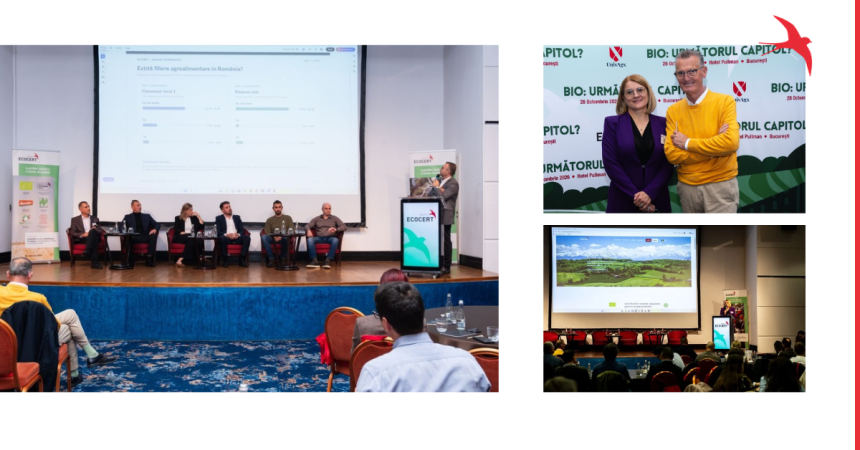
How can Romania turn its organic production potential into a stronger, more connected value chain? This question was at the heart of the second National Conference dedicated to organic agriculture, organized by Ecocert Romania in Bucharest under the theme “ORGANIC: The Next Chapter?”.
The event brought together agri-food professionals to exchange perspectives on the challenges and opportunities shaping the country’s organic market, from developing local production and strengthening processing and distribution capacities to encouraging consumption and building consumer trust. Building on the first edition held in 2025, the conference broadened the conversation beyond agricultural production to consider the entire organic value chain.
- A market with significant potential
Liliana Ciobanu, General Manager of Ecocert Romania, opened the conference with a presentation on“Trends in Romania’s Organic Market”, highlighting both the sector’s potential and the structural gaps that continue to limit its development.
- A few key figures illustrate this potential
📌 Around 15,000 farms are engaged in organic agriculture in Romania
📌 799,000 hectares are under organic production, representing around 6% of the country’s total agricultural area
📌 Organic products currently account for only 1–2% of consumer purchases, compared with 5.8% in France
The figures also point to a challenge beyond production itself. The country has 490 certified enterprises in processing and distribution, compared with 24,679 in France, highlighting the importance of turning agricultural production into finished products that can reach the domestic market.
- Building stronger organic value chains
One of the conference’s interactive sessions provided another insight into the challenges ahead: 84.1% of the 44 professionals surveyed said that organic agri-food value chains exist in Romania, but remain too few. The survey also identified prices and production costs, bureaucracy, insufficient education and awareness, limited demand, and difficulties in cooperation among market players as key obstacles. The results are exploratory and do not constitute a nationally representative survey.
This echoed one of the main messages of the event: strengthening the sector requires a better-connected value chain, bringing together producers, processors, distributors and consumers. Discussions highlighted the importance of combining production with sufficient processing capacity, market access, stronger cooperation and measures to stimulate domestic consumption.
- Learning from the French experience
The conference also brought an international perspective through Thierry Stoedzel, COO of Ecocert Europe, who joined remotely to present “Organic Agriculture in France: Achievements and Challenges.”
His contribution offered participants an opportunity to look at the evolution of organic agriculture through the experience of a more mature European market. One key takeaway was that market maturity does not eliminate challenges, but accumulated experience can provide useful guidance for countries at different stages of development.
- Soil health and long-term expertise
The discussions also addressed the technical foundations of organic farming. Paolo Barchetta, agronomist and consultant at MONDOBIO, focused on soil fertility, long-term crop rotations, organic matter and cover crops, as well as the need to connect production choices with processing and market opportunities.
His intervention reinforced another important message from the conference: organic farming requires long-term planning, agronomic expertise and practices adapted to each farm, with soil considered as a living ecosystem.
- Connecting the entire value chain
From market development and the French experience to soil health and cooperation between stakeholders, this second edition highlighted a common priority: transforming production potential into a functional value chain capable of creating economic value, supporting sustainable practices and meeting consumer expectations.
Through this National Conference, Ecocert Romania continues to create opportunities for professionals to share knowledge, discuss concrete market challenges and strengthen connections across the organic sector.
Discuss these topics and your projects with our team! Contact us.